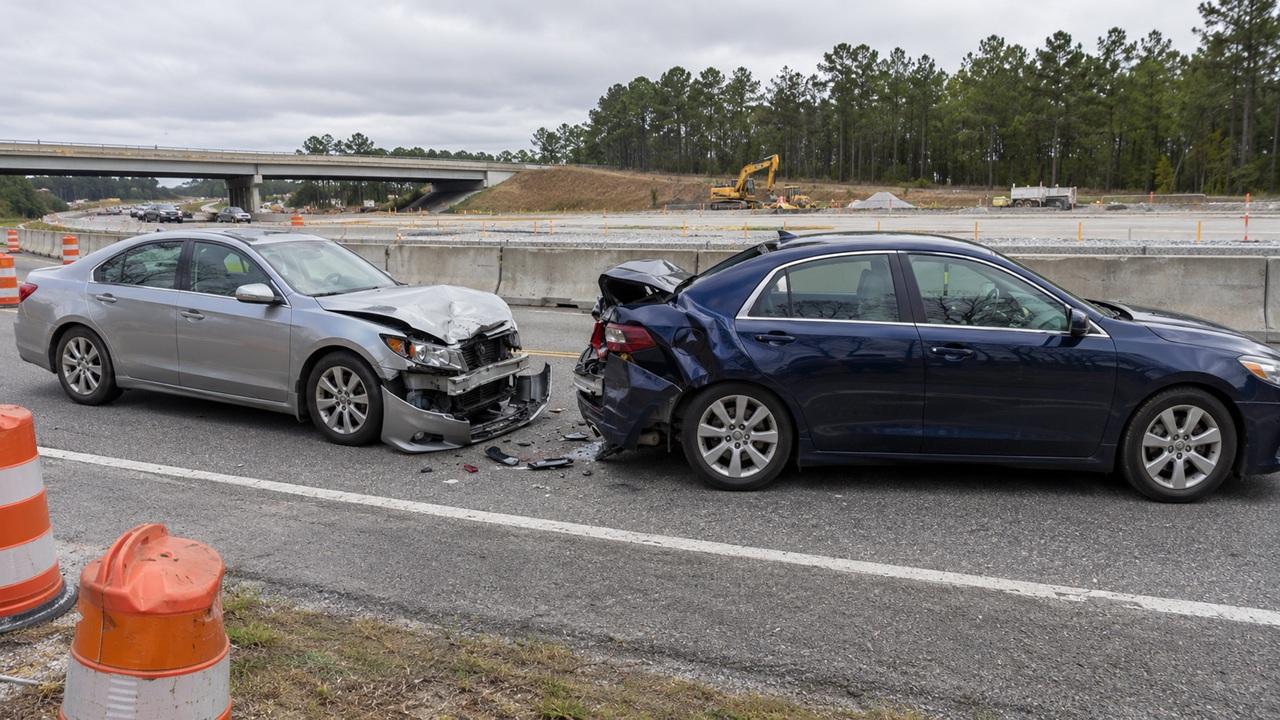
Careless Drivers and Construction Contractors Can Both Share the Blame for Crashes at "Malfunction Junction"
Carolina Crossroads work zone crashes have become a serious concern for South Carolina drivers who travel through the Midlands. The project is reconfiguring 14 miles of the I-20/I-26/I-126 corridor, one of the largest construction efforts in state history. According to the Carolina Crossroads project site, more than 134,000 vehicles pass through the corridor every day.
All that traffic now moves through shifting lanes, narrowed shoulders, and nighttime closures. Construction vehicles also enter and leave the work area. Each change adds risk, especially for drivers who don't expect a lane to end or a ramp to move. When a crash happens in that setting, the question of who's responsible can reach beyond the other driver.
|
Work Zone Crash Liability at a Glance
|
Work zone crashes often involve more than one responsible party. Each one may point the finger at someone else. A Lexington car accident lawyer can sort out who caused the crash. That same lawyer can preserve evidence of how the work zone looked that day. That evidence can disappear quickly as crews move barrels and shift lanes.
Where Carolina Crossroads Construction Stands Now
SCDOT has broken the project into phases, and the work zone keeps changing as each one starts and finishes. According to the project phases page, Phases 1, 2, and 3B are complete. Phase 3C is under construction and about 25% complete. It replaces the I-20 bridges over the Saluda River and CSX railroad and adds pavement width to I-20. Completion is expected in 2029.
More work is on the way. Phases 3A and 4/5 are expected to be under construction in 2027. Phase 3D is set to begin in 2029. Phase 3E, which rebuilds the I-20/I-26 interchange itself, is expected to start in 2030. SCDOT expects the entire project to be substantially complete in the mid-2030s.
That timeline means drivers will deal with Crossroads work zones for years. Lane patterns, exits, and closures will keep changing as phases begin and end. The setup in place on the exact day of a crash can matter a great deal. That's why documenting it right away is so important.
When Another Driver Causes a Work Zone Crash
Most work zone crashes start with a driver's mistake. Speeding through the zone or looking at a phone can turn a sudden slowdown into a rear-end collision. So can following too closely in stop-and-go traffic. Drivers who ignore merge signs or cut in at the last second can sideswipe other vehicles in narrowed lanes.
Impaired drivers pose an even greater danger in these tight spaces. Work zones leave little room to recover from a mistake. Concrete barriers can turn a minor drift into a serious crash. Construction vehicles entering and leaving the work area add another hazard that inattentive drivers may not see in time.
When another driver causes the crash, that driver's auto insurance is usually the first source of compensation. Insurance companies often try to blame the injured driver or the work zone itself. Their goal is to reduce what they pay. Never give a recorded statement to the other driver's insurance company. A lawyer can handle every conversation with it.
Can a Construction Contractor Be Held Liable?
Yes, in some cases. Contractors working on highway projects are responsible for setting up and maintaining temporary traffic control. That includes signs, cones, barrels, barriers, pavement markings, and lighting for night work. The federal Manual on Uniform Traffic Control Devices (MUTCD) sets national work zone standards. Those standards spell out how signs and devices should guide drivers safely.
A contractor may share responsibility when the setup falls short. Warning signs may be too close to an abrupt lane shift to give drivers time to react. Old pavement markings may conflict with new ones, sending drivers toward a closed lane. Uneven pavement edges and equipment left in a travel lane can also create danger. So can poor lighting during nighttime work.
Contractors often defend these claims by arguing they followed the traffic control plan approved by SCDOT. Proving otherwise usually takes photos and video from the crash scene, along with the project's own records. A lawyer can request the traffic control plans and daily logs. Those records show what was supposed to be in place, which can be compared to what drivers actually saw.
What About SCDOT Itself?
Claims against state agencies like SCDOT follow a different set of rules, and they're often harder to win. The South Carolina Tort Claims Act governs most injury claims against government entities in the state. It allows some claims but protects government agencies from others.
The law includes exceptions that can shield agencies from responsibility for certain decisions. It also limits how much money can be recovered. The act sets its own deadlines and procedures, which differ from those in a typical car accident claim. Missing one of those requirements can end a claim before it starts.
These cases call for careful legal review from the beginning. Whether a claim against SCDOT makes sense depends on what went wrong in the work zone. It also depends on who was in charge of that part of the project. A lawyer can decide whether the state, a contractor, or both belong in the case.
Who May Be Liable in a Work Zone Crash
Work zone crashes can involve several parties at once. Here's how each one may contribute and the kind of evidence that tends to matter most.
| Party | How They May Contribute | Evidence That Matters |
|---|---|---|
| At-Fault Driver | Speeding, distraction, tailgating, or unsafe merging | Crash report, dashcam video, witness statements |
| Construction Contractor | Poor lane shifts, missing signs, or hazards left in the roadway | Scene photos, traffic control plans, daily logs |
| Traffic Control Subcontractor | Barrels, signs, or markings placed or maintained poorly | Inspection records and setup documentation |
| SCDOT | Only in limited situations under the Tort Claims Act | Project records and approved plans |
A single crash can involve a careless driver and a confusing lane shift at the same time. Each party will likely blame the others, and their insurance companies will push that strategy hard. Building a clear picture of every cause from the start protects the injured driver's right to full compensation.
How South Carolina's 50% Rule Works
South Carolina follows a modified comparative negligence rule. An injured driver can recover compensation as long as he or she is 50% or less at fault. Any award is reduced by that driver's share of the blame. Being 20% at fault, for example, means recovering 80% of the total.
Recent changes make naming every responsible party even more important. Under South Carolina Code Section 15-38-15, a defendant less than 50% at fault generally pays only its own share. Starting in 2026, defendants can also ask a jury to assign fault to someone outside the lawsuit. A contractor is one example, as long as that party is identified in time.
That means an at-fault driver's insurance company may try to shift blame onto the work zone setup. The injured driver can respond by adding that party to the case. Investigating the contractor's role early keeps that option open. It also keeps an empty chair from absorbing part of the blame.
Evidence to Preserve After a Work Zone Crash
Work zones change constantly, and the conditions that caused a crash may be gone within a day. These steps help protect the evidence that can prove what happened.
- Photograph the Work Zone – Capture signs, cones, barrels, lane markings, and lighting from several angles before crews move anything.
- Save Dashcam Footage – Video from your vehicle or other drivers can show the lane shift, signs, and traffic flow at the moment of the crash.
- Get the Crash Report – The officer's report records the location, conditions, and initial findings about what caused the crash.
- Collect Witness Information – Other drivers and construction workers can describe what they saw and how the work zone was set up.
- Keep Medical Records – Prompt treatment protects your health and documents how the crash affected you.
- Talk to a Lawyer First – A lawyer can request traffic control plans and project records and handle all contact with insurance companies.
Some of the most important evidence isn't available to the public, including the contractor's daily logs and traffic control plans. A lawyer can demand that it be preserved before it's lost or changed. Acting quickly gives the injured driver the strongest possible case against everyone who played a role.
Get Serious About Your Work Zone Crash Claim
Johnson + Johnson Attorneys at Law helps injured drivers in Lexington, Columbia, and throughout South Carolina. Brothers Kevin and Steven Johnson were born and raised in Lexington. They know the roads through the Midlands firsthand. Kevin worked in the insurance industry and for firms that defended insurance companies. That means we know the tactics they use to limit claims.
Our case results include a $200,000 recovery in an auto accident case, which collected the full liability and uninsured motorist policy limits. We investigate every crash, review reports and records, interview witnesses, and work with accident reconstruction experts when needed. We're ready to negotiate a fair settlement or take your case to court. Our family fights for yours.
Hurt in the Carolina Crossroads work zone? Get serious and get Johnson + Johnson on your side.
"Steven was awesome from start to finish. Great communication and results that were way better than I expected. I'll definitely be returning if the need shall ever arise! This guy knows what he's doing and seems to care for his clients more than anyone I've ever worked with." - Taylor J., ⭐⭐⭐⭐⭐