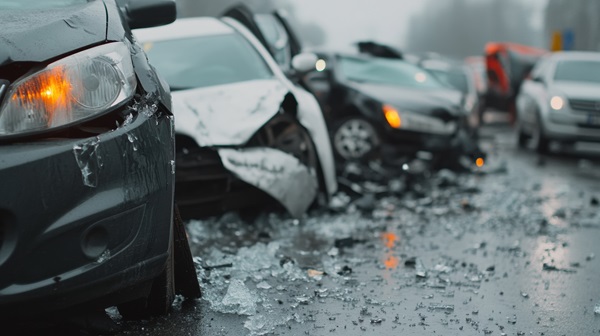
When a single collision involves three, four, or five vehicles, the scene is more than just a car accident; it's a legal puzzle. In South Carolina, insurance companies often use the "domino effect" of a chain reaction crash to dodge accountability, pointing fingers at every driver involved to avoid paying a single claim. At Johnson + Johnson, Attorneys At Law, we know that being stuck in the middle of a multi-car pileup doesn't make you responsible for it. We cut through the confusion of competing driver statements and biased police reports to prove exactly which negligent act set the disaster in motion.
Why do chain-reaction car accidents happen?
Multi-vehicle collisions can unfold in many different ways, often within a few seconds. Common causes of multi-car crashes include:
- Sudden stop in heavy traffic – When drivers stop fast without warning, other cars can crash into each other and start a domino effect that pushes several vehicles forward.
- Distracted drivers – People texting on their phones, looking up directions, or changing the radio can cause chain-reaction accidents in a split second.
- High-speed impact from behind – A speeding driver on the interstate who fails to slow down for congestion can crash into the last vehicle in line and send that vehicle into others.
- Impaired drivers – Drunk drivers or drivers under the influence of drugs often don’t stop or slow down in time, resulting in a chain-reaction accident.
- Tired drivers – When drivers are tired or fall asleep at the wheel, the consequences can be catastrophic, especially if they’re traveling on a busy highway with stopped or slower vehicles.
- Secondary crashes around the first wreck – Drivers coming upon an existing crash hit disabled vehicles in the roadway because they are distracted or do not move over.
In each of these situations, more than one driver might have done something wrong. Some may have been driving too fast. Others may have been distracted, tailgating, or failing to keep a proper lookout. When multiple bad decisions collide, the result is a confusing scene that is hard to untangle without a careful investigation.
Who can be held responsible in a chain reaction crash?
Responsibility in a multi-car crash often extends beyond the driver who first made contact. Potentially at-fault parties can include:
- Initial rear driver – The person who failed to stop in time often carries a significant share of fault, especially if speeding, distracted driving, or impaired driving is involved.
- The following drivers – Drivers who follow too closely or fail to pay attention may be responsible for additional impacts that make injuries worse.
- Driver who cut into the lane – Someone who changed lanes suddenly without signaling or who braked sharply for no reason can trigger the entire chain reaction, even if that vehicle is not the one that hits you.
- Commercial drivers and employers – When an overloaded truck, delivery van, or work vehicle is involved, the company that owns or operates that vehicle may also be responsible for unsafe policies or poor maintenance.
- Drivers who ignore hazard lights or road flares – In secondary crashes, people who do not slow down or move over around an existing wreck may be held responsible for new injuries.
Drivers should also be wary of the "Sudden Emergency Doctrine." In South Carolina, a defendant might argue they aren't liable because they were reacting to an "unforeseen" hazard. However, heavy traffic on I-26 is a foreseeable reality, not a legal emergency. We push back against this defense by showing the driver had ample time to maintain a safe following distance. If they hit you, it wasn't a "sudden emergency." It was a failure to adjust to South Carolina road conditions.
The key point is that fault is not a simple all-or-nothing decision. It's a careful analysis of how each driver’s choices contributed to what happened. That's why a detailed investigation is critical in South Carolina chain reaction accidents.
How does South Carolina’s comparative negligence rule affect fault?
South Carolina uses a modified comparative negligence system, often called the “51 percent rule.” You can recover compensation as long as you are 50 percent or less at fault for the crash. If you are found 51 percent or more responsible, you cannot recover damages (financial compensation) from the other driver or drivers.
In a chain reaction accident, this rule becomes very important. Insurance companies know that if they can push your share of fault over that 50-percent line, they may avoid paying anything at all. Even a small shift in how fault is divided can mean the difference between a meaningful recovery and nothing.
When several vehicles are involved, the fault percentages for all drivers must add up to 100 percent. For example, if one driver is found 60 percent at fault and another 40 percent at fault, the person who is 60 percent responsible may have to pay the full amount of your financial losses. Your own actions are also considered. If you are found 20 percent at fault and your total losses are $100,000, your recovery would be reduced to $80,000. With so much at stake, you want someone in your corner making sure blame is assigned fairly and accurately.
What evidence matters most in a multi-vehicle crash?
In a chain reaction accident, simply looking at where vehicles ended up is not enough. To prove what really happened, your legal team should focus on gathering detailed evidence such as:
- Accident scene photos and video – Images of skid marks, vehicle positions, debris, and road conditions help show speeds, braking, and the direction of each impact.
- Dashcam and traffic camera footage – Video may reveal sudden lane changes, tailgating, distractions, or a driver who never touched the brakes before the collision.
- Event data recorders – Many vehicles store speed, braking, and throttle information, which can be downloaded and analyzed to show how each driver behaved before impact.
- Witness statements – Independent witnesses can describe which vehicle started the chain reaction, whether brake lights came on, and whether any driver seemed distracted or impaired.
- Police reports and citations – While not the final word on fault, police observations and any tickets issued can be powerful supporting evidence.
The more thorough the investigation, the harder it is for an insurance company to rewrite the story in a way that shifts blame toward you.
Frequently asked questions: South Carolina chain reaction crashes
Is the person at the very back of the chain always at fault?
Not necessarily. While the "rear" driver often triggers the event, the middle driver could be held partially liable if they were tailgating so closely that they hit the car in front of them before being struck from behind. We analyze the "number of impacts" felt by victims to determine the exact sequence of the collision.
What if the driver who started the chain reaction fled the scene?
This becomes an Uninsured Motorist (UM) claim. Even if the "phantom vehicle" is never found, your own insurance policy in South Carolina is required to provide coverage for hit-and-run incidents, provided there is physical evidence or witness testimony that the other vehicle caused the crash.
How do you prove who hit whom first in a four-car pileup?
We look at the "crush data" and sensor logs. Modern cars record the exact millisecond of airbag deployment and impact. By syncing the timestamps from all involved vehicles, we can create a digital timeline that shows whether Car A hit Car B before Car C joined the wreck.
Can I sue multiple drivers at once?
Yes. In a multi-vehicle crash, we often file claims against several insurance policies. Under South Carolina's rules of joint and several liability, if one driver is more than 50% at fault, they can potentially be held responsible for the entire judgment if other involved drivers are underinsured.
What if a mechanical failure, like a tire blowout, caused the first hit?
If a commercial truck started the chain reaction due to a blowout, the liability might shift to the maintenance company or the tire manufacturer. These "product liability" claims are complex but can significantly increase the available insurance coverage for everyone injured in the pileup.
Learn how South Carolina's comparative negligence rules affect your claim
Chain reaction collisions often quickly turn into contested legal cases in South Carolina. Several drivers, insurance companies, and complicated fault rules all collide at once. On your own, it can be difficult to push back and demand the compensation you rightfully deserve.
When you involve Johnson + Johnson, Attorneys At Law, early in the process, you can shift the focus onto you and your legal needs. We take the time to investigate how your crash started and pursue the full compensation you deserve for medical bills, lost income, and other ways the crash has changed your life.
We’re proud of our case results, including a $200,000 settlement for a car accident injury victim. Contact us to learn more about how we can help you. Schedule a free consultation at our Lexington, SC law firm. We work on a contingency fee basis. That means you pay nothing unless we recover compensation on your behalf.
“Steven was awesome from start to finish. Great communication and results that were way better than I expected. I’ll definitely be returning if the need shall ever arise! This guy knows what he’s doing and seems to care for his clients more than anyone I’ve ever worked with.” – Taylor J., ⭐⭐⭐⭐⭐